
Permit application may be submitted at City Hall located at 811 Avenue D Abernathy, Texas 79311 or via email at [email protected] or through our permitting software: CLOUD PERMIT at cloudpermit.com/gov/login. To submit your application, create a profile, submit your plans and licensing information, and don’t forget to sign off on the application before submittal. Once you have completed the plan review process an invoice will be generated. You must bring payment and invoice to City Hall to receive your building permit and building permit placard. We can only accept cash or check for this transaction.
For building permits within a “Special Flood Hazard Area” on a flood map issued by the Federal Emergency Management Agency (FEMA), you MUST obtain a Floodplain Development Permit from the City before a Building Permit is issued (see Floodplain Development requirements below). Abernathy Zoning Ordinance 310 has certain setback requirements for every type of construction. The permit application may be denied if the proposed construction is outside of the designated setback area. For questions regarding Permit Requirements, Flood Hazard Areas, or Zoning Setbacks, please contact City Hall.
Building Permit Requirements
You are required to have a building permit if you are constructing, erecting, or moving in:
- Any residential or commercial building.
- A carport, pergola, gazebo, or deck.
- Any accessory (storage or shop) building larger than 200 square feet.
- Any addition or alteration to an existing residential or commercial building.
- A swimming pool.
- Fences.
- Window Replacements
- Driveway approach
- Roof Repairs
Before the City of Abernathy can issue a building permit, you must submit a Building Permit Application through our Cloud Permit software (noted above). A plan review will be conducted. All applications for building permits must include the following:
- One complete set of plans and specifications
- Foundation detail*
- Plat showing property lines, existing buildings, easements, and proposed new construction
- Texas Architectural Barriers Act / EABPRJ# (for commercial projects valued over $50,000)
Foundation Detail
A foundation detail is required for all types of construction listed above, however, a complete set of plans and specifications may not be required by the Building Inspector for certain types of construction.
Construction that does not require a permit includes:
- Cement flatwork
- Siding replacement
- Retaining walls not over 4 feet
- Painting, papering, tiling, carpeting, cabinets, countertops and similar finish work.
- Prefabricated swimming pools that are less than 24 inches deep.
- Swings and Playground equipment
- Decks not exceeding 200 square feet in area, that are not more than 30 inches above grade at any point, are not attached to a dwelling and do not serve the exit door required by Section R311.4 of the IRC.
- Other alterations and repair work determined by the building official to be of a minor nature.
Plumbing Permits
Plumbing permits are required for:
- New construction with plumbing services or fixtures
- Yard gas line installation or replacement
- Propane installation
- water heater replacement
- Installation of new water, sewer, and/or gas/propane lines in an existing building
Plumbing permits are NOT required for:
- Repair or replacement of plumbing fixtures
- Sewer line clearing
- Other minor plumbing repairs
Electrical Permits
Electrical permits are required for:
- New construction with electrical services attached
- Meter Socket Replacement*
- Electrical line replacement
- Installation of new wiring in an existing building
Electrical permits are NOT required for:
- Minor electrical repairs
- Temporary decorative lighting
- Reinstallation of attachment of plug receptacles but not the outlets therefor.
- Replacement of branch circuit overcurrent devices of the required capacity in the same location.
- Electrical wiring, devices, appliances, apparatus or equipment operating less than 25 volts and not capable of supplying more than 50 watts of energy.
* Xcel Energy services the vast majority of services within the City of Abernathy. They may have special requirements involving meter sockets that are independent and stricter than the required City Codes.
NOTICE: if you are making electrical repairs to more than 50% of an existing electrical system, all electrical elements must be brought into compliance with the current electrical code.
Mechanical Permits
Mechanical permits are required for:
- New construction with mechanical services attached
- Installation of an HVAC system on an existing home where one hasn’t been previously installed.
Mechanical permits are NOT required for:
- Minor mechanical repairs or servicing
- Portable heating appliances
- Portable ventilation appliances.
- Portable cooling units
- Steam hot- or chilled-water piping within any heating or cooling equipment regulated by code.
- Portable evaporative coolers
- Self-contained refrigeration systems containing g10 pounds or less of refrigerant or that are actuated by motors of 1 horsepower or less.
Irrigation Permits
Irrigation permits are required for:
- Installation of new or replacement irrigation systems
Irrigation permits are NOT required for:
- Minor repairs to an existing irrigation system
Contractors repairing or installing an irrigation system must have a license issued by Texas Commission on Environmental Quality (TCEQ). Homeowners may install or repair their own irrigation system, providing it is your homestead and you are not intending to sell it in the next twelve (12) months.
A Backflow Assembly Test Report is required for all new irrigation systems. This must be conducted by a licensed TCEQ Backflow Tester and filed with the city or the city’s third-party company. Periodic testing is required.
Permit Fees
Permit fees must be paid with the submission of a Building Permit Application. In the event permit(s) is/are not issued, the amount paid will be refunded. Once the permit has been issued, the amount paid is non-refundable.
Permit fees can be found in Appendix A of the City of Abernathy Code of Ordinances.
Expiration of Permits
Permits expire if work has not started within 180 days, or if the work has stopped for 180 days. The permit may be extended one (1) time, if requested in writing prior to expiration.
Floodplain Development
The National Flood Insurance Program (NFIP) provides flood insurance to individuals at much lower premiums than could otherwise be purchased through private insurers and makes certain federal monies available to local communities. In order for citizens to be eligible for the national flood insurance rates, or for communities to receive certain kinds of federal monies, the community must agree to meet minimum floodplain standards.
The City of Abernathy has adopted a Flood Damage Prevention Ordinance (found in Article 3.05 of the Abernathy Code of Ordinances).
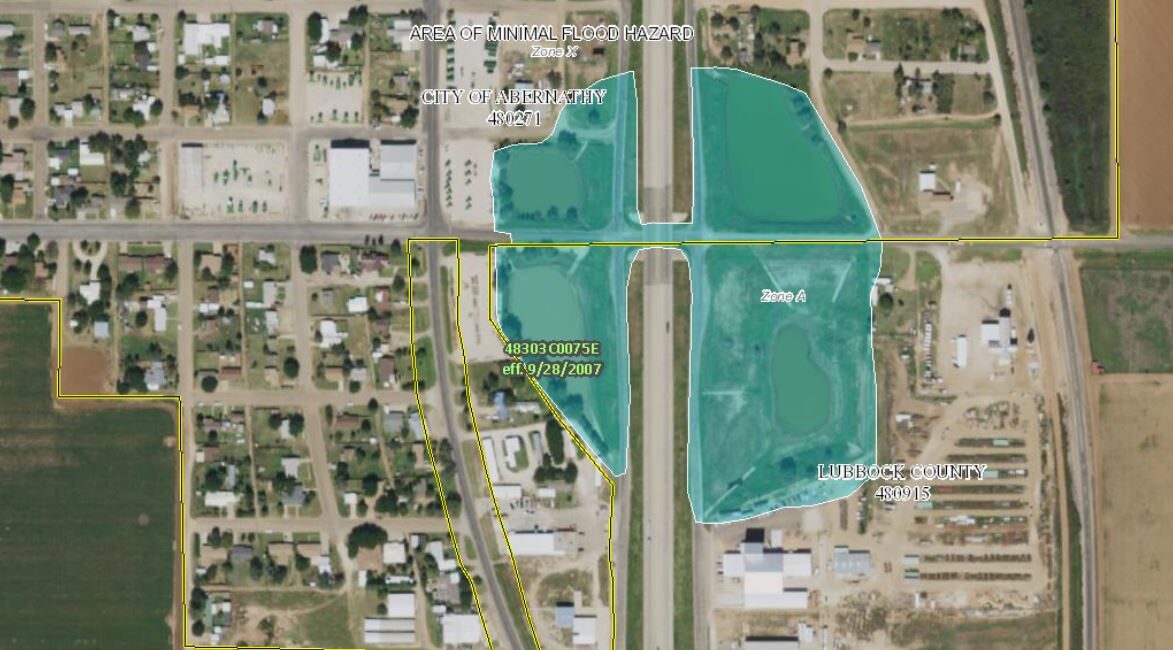
If the property which you proposed to develop is located within a “Special Flood Hazard Area” on a flood map issued by the Federal Emergency Management Agency (FEMA), you MUST obtain a Floodplain Development Permit prior to beginning the project. There are penalties for failing to do so. To see if your property is located within a Special Flood Hazard Area, search the FEMA Flood Map Service Center and follow the instructions on that page. At this time, FEMA has designated all Special Flood Hazard Areas in the City as “Zone A” – without base flood elevations.
NOTE: the issuance of a Floodplain Development Permit does not automatically exempt you from having to purchase flood insurance. You may buy flood insurance for your peace of mind, you may be required to buy it before a lending institution will make or refinance a loan, or you may not buy flood insurance at all.
Required Submissions
Required submissions may include:
- Floodplain Development Permit Application
- Three (3) complete sets of plans, sealed by a Texas-registered engineer, architect, or land surveyor
- Elevation Certificate
- Floodproofing Certificate
- No-Rise/No-Impact Certificate